Challenging Maslow’s Hierarchy of Needs
Maslow’s Hierarchy of Needs says you can predict how people will behave by looking at their underlying needs.
Maslow believed, for example, a starving person would find food first, putting aside every other consideration including social niceties.
Maslow's theory useful but flawed
While Maslow’s theory has its uses, most modern management experts and psychologists regard it with suspicion. One obvious criticism is that the hierarchy doesn’t take into account acts of selflessness, bravery, charity and heroism.
You might ask yourself why some German citizens hid Jews from the Nazis. Or why starving servicemen in Japanese prisoner of war camps would give up their own food supplies to help the weak and dying. But then most economists and biologists would also find these seemingly irrational acts hard to explain.
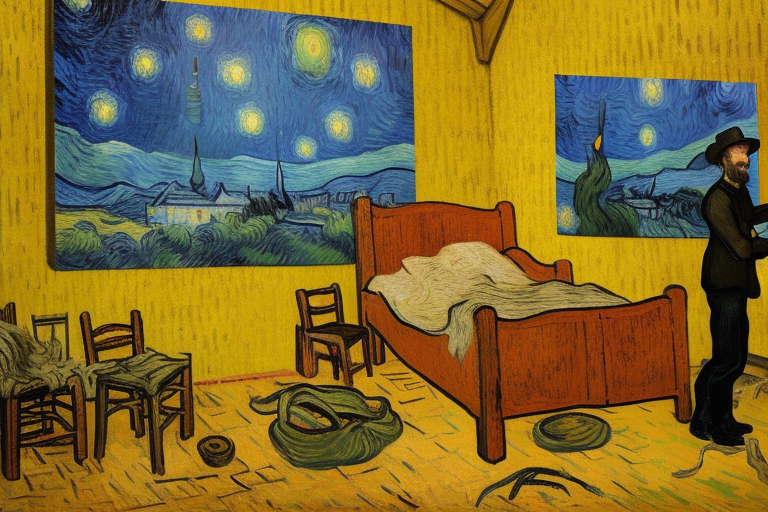
Likewise, many of the best and most creative painters and poets – who Maslow would describe as self-actualising – were starving in attics when they did their best work. Where does Vincent van Gogh sit on the hierarchy of needs?
Creativity and poverty
We can all think of examples of filmmakers, musicians and other artists whose creativity dried up when they hit the big time. Years ago I worked as a music journalist and discovered many financially challenged rock bands would deliver a brilliant first album, score a huge contract and then wallow self-indulgently in the studio for album number two. Many never got the opportunity to make a third record.
Jim Clemmer and Art MacNeil make an important criticism of Maslow’s Hierarchy of Needs theory in their book “Leadership skills for Every Manager” (ISBN 0861889630). The book is out of print, but you may find a copy in a decent university library (If you’ve got it and no longer want it, get in touch with me).
Hierarchy of Needs: misses the point
Clemmer and McNeil suggest that Maslow misses the point because he left people’s spiritual dimension out of the picture. They say that humans look for meaning in their lives and that meaning transcends any animalistic drives.
In their words, “even starving people are not immune to the lure of higher values.” Think about van Gogh.
A more scientific criticism was published in the 1977 edition of “The Annual Review of Psychology”. Here, A.K. Korman, J.H. Greenhaus and I.J. Badin wrote that there’s no empirical (that is, researched) evidence to support Maslow’s ideas. In fact, they argue the empirical evidence points in the opposite direction. Other critics have pointed out that Maslow came up with his theories after observing only a handful of people and it lacks scientific rigor.
We’ll leave these debates for the academics.
The important thing about Maslow’s idea is it is a good, maybe crude, starting point for understanding what drives people. The Hierarchy of Needs provides a useful template that can help explain how and why people behave.
[...] The Knowledge Workers ’s blog today posted an interesting piece about perspective in Challenging Maslow’s Hierarchy of Needs which is excerpted [...]
Knowledge Workers and Maslow’s Heirarchy…02.02.09 « The Proverbial Lone Wolf Librarian’s Weblog
3 Feb 09 at 4:40 am
[...] Challenging Maslow’s Hierarchy of Needs (billbennettnz.wordpress.com) [...]
Unemployment, Capitalism 2.0 and Maslow’s Hierarchy « I want to be a dancer
3 Mar 09 at 7:04 pm
As you said, you’re oversimplifying Maslow’s theory.
An important omission is that the first four needs in the hierarchy are sufficiency needs: people will pursue them until they have *sufficient* food, security, whatever, to meet their needs at this time.
So a “starving” artist may still have eaten enough today to satisfy their need for food, even if it wouldn’t satisfy yours (or the artist’s at a different point in their life).
ldrydenb
9 May 09 at 4:16 pm
Your article assumes you need to be at the level of self-actualization to make art. I don’t think Maslow would have automatically made this assumption about these people. Even small children can make art.
These supposed “artists” were using art as a means of satisfying their lower needs (food, security, maybe even external self-esteem, i.e. proving “them” wrong). Once their lower needs were met, the passion to create went away.
It’s probable that none of them were at the level of self-actualization. Remember, only 2% of the population gets to this level.
What motivates humans is extremely complex, Maslow was merely offering a model to explain the most common motivations. It was never intended to explain the anecdotes.
lvl4
31 Jul 09 at 12:54 pm
[...] of stress and anxiety.Criticism of Maslow’s HierarchyNot everyone agrees with Maslow. Many challenge the hierarchy because it doesn’t account for selfless acts, bravery and charity. Nor does it account for [...]
Designing For A Hierarchy Of Needs - Smashing Magazine
27 Apr 10 at 12:05 am
[...] of stress and anxiety.Criticism of Maslow’s HierarchyNot everyone agrees with Maslow. Many challenge the hierarchy because it doesn’t account for selfless acts, bravery and charity. Nor does it account for [...]
Designing For A Hierarchy Of Needs - Smashing Magazine
27 Apr 10 at 12:05 am
[...] everyone agrees with Maslow. Many challenge the hierarchy because it doesn’t account for selfless acts, bravery and charity. Nor does it account for [...]
Designing For A Hierarchy Of Needs | Web Design Cool
27 Apr 10 at 12:22 am
[...] of stress and anxiety.Criticism of Maslow’s HierarchyNot everyone agrees with Maslow. Many challenge the hierarchy because it doesn’t account for selfless acts, bravery and charity. Nor does it account for [...]
Designing For A Hierarchy Of Needs | DesignerLinks | Home to Web design news, jQuery Tutorials, CSS tutorials, Web Designing tutorials, JavaScript tutorials and more!
27 Apr 10 at 2:35 am
[...] everyone agrees with Maslow. Many challenge the hierarchy because it doesn’t account for selfless acts, bravery and charity. Nor does it account for [...]
Designing For A Hierarchy Of Needs | CMS Code
27 Apr 10 at 3:01 am
[...] everyone agrees with Maslow. Many challenge the hierarchy because it doesn’t account for selfless acts, bravery and charity. Nor does it account for [...]
Designing For A Hierarchy Of Needs | MarketingTypo.com
27 Apr 10 at 3:15 pm
[...] feelings of stress and anxiety.Criticism of Maslow’s HierarchyNot everyone agrees with Maslow. Many challenge the hierarchy because it doesn’t account for selfless acts, bravery and charity. Nor does it account for the [...]
Designing For A Hierarchy Of Needs | Best Web Magazine
28 Apr 10 at 10:30 am
[...] everyone agrees with Maslow. Many challenge the hierarchy because it doesn’t account for selfless acts, bravery and charity. Nor does it account for the [...]
Designing for a Hierarchy of Needs
28 Apr 10 at 5:33 pm
[...] everyone agrees with Maslow. Many challenge the hierarchy because it doesn’t account for selfless acts, bravery and charity. Nor does it account for the [...]
Designing For A Hierarchy Of Needs « qeqnes | Designing. jQuery, Ajax, PHP, MySQL and Templates
28 Apr 10 at 10:02 pm
[...] everyone agrees with Maslow. Many challenge the hierarchy because it doesn’t account for selfless acts, bravery and charity. Nor does it account for [...]
Designing For A Hierarchy Of Needs | STMGZN
29 Apr 10 at 8:45 pm
[...] everyone agrees with Maslow. Many challenge the hierarchy because it doesn’t account for selfless acts, bravery and charity. Nor does it account for [...]
Designing For A Hierarchy Of Needs | i know idea
1 May 10 at 2:17 pm
Interesting thoughts. I guess like any theory or model of behaviour that describes “everyone” it cannot describe specific people, because everyone has their own nuances. It can only give a best guess or guide to how the majority might behave.
Also one could argue that it is fundamentally flawed as it assumes that people are rational – though I guess that’s just a loose paraphrase of exactly what you’re arguing. My point also assumes that we can agree on what “rational” behaviour is.
Martin
6 Sep 10 at 4:38 pm
Hi Martin
I don’t think the Hierarchy of needs is based on rational thinking – it’s deeper than that and about basic psychology. At the bottom it’s more along the lines of “I’m cold and hungry, I need warmth and food” – a response which applies to humans and animals.
Bill Bennett
7 Sep 10 at 3:00 pm