Mobile networks in New Zealand
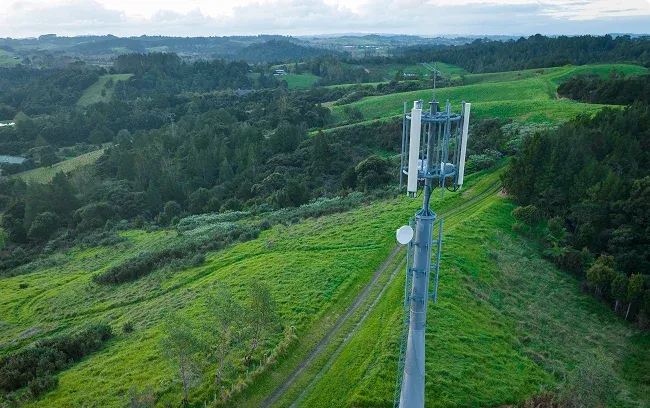
Extensive coverage, wide use
New Zealand’s geography means mobile networks cover roughly half the nation’s landmass but close to 100% of where people live and work.
The networks are used by almost every adult. In 2024 there were 6.84 million active cellular connections or around 130% of the population. (Data from Digital 2024: New Zealand report)
Mobile networks are New Zealand’s most widely used communications infrastructure for voice, messaging and data, but fibre networks handle far larger data volumes.
How the mobile networks are used
New Zealand’s mobile networks have displaced landlines for voice calls. Around seven million calls are made each day.
The three networks handle over four billion text messages and carry around 20 petabytes of mobile data each month.
Fixed-wireless broadband, which is delivered by the mobile networks, accounts for around 20% of land-based broadband. New Zealand has one of the highest adoptions of this technology.
Mobile networks are used not only by people, but also by IoT devices.
Where mobile networks fall short
Mobile networks offer over 99% coverage in urban areas. There can be capacity issues in busy city centres and where large crowds congregate. While there are a few dead spots, on the whole, urban coverage is excellent.
Coverage is far from comprehensive in rural, coastal and mountain regions. There are also gaps on highways. New Zealand’s geography is challenging for networks.
Government subsidies have helped the Rural Connectivity Group, a joint venture between the three mobile carriers, to fill in network gaps on roads and provide coverage to smaller communities. Beyond that, mobile-to-satellite is emerging as a way of reaching beyond tower networks.
Competition and market structure
The Commerce Commission is concerned that three mobile networks account for 97.5 percent of the market. New Zealand remains among the bottom OECD countries for MVNO (mobile virtual network operator) penetration.
Despite the lack of competition, entry-level and average-use mobile plans are often 40% cheaper than OECD averages. While high-volume data plans have historically been more expensive, recent data suggests NZ mobile rates are now competitive internationally.
There is no mobile wholesale market in the same sense there is in fibre broadband. While there has been historic regulatory intervention to level the playing field and ease the entry of a third carrier, the market structure is not regulated.
Intense competition between the three carriers has squeezed margins to the point where MVNOs struggle to compete on price. Instead they mainly focus on more creative ways of bundling services and data or extending brand names established in other markets.
Mobile infrastructure, mainly towers, was central to competition in the past, but this has faded to the point where mobile carriers sold their towers to specialist companies. Two of the carriers use just one of these companies.
Resilience and emergency use
Mobile is the primary way people contact emergency services.
More than 82% of 111 calls in New Zealand are made from mobile phones.
They now relay Emergency Location Information (ELI) which is sent to responders. A second service, Device Location Information (DLI) helps locate, at-risk individuals even if they cannot call.
New Zealand’s mobile networks play an important role in major weather emergencies which have become more common and more damaging in recent years.
However, the networks are vulnerable, especially when power is interrupted. Many towers have emergency backup power but they can be located in hard to reach places making refuelling diesel generators a problem. Increasingly people in rural and remote areas are becoming dependent on mobile-to-satellite technology in disasters.
Further reading on mobile networks
• First NZ 5G trial networks from Spark and Vodafone — early look at how 5G was introduced
• Rural mobile closing the gap thanks to RCG — network experience in country areas is improving
• One NZ scores world first with satellite-to-mobile — where mobile coverage ends
• Three telcos control 97.5% of NZ mobile market, regulator warns — Commerce Commission concerned about market concentration
This page is part of a series of background briefings on New Zealand’s telecommunications industry:
- Telecommunications regulation in New Zealand
- Fibre networks in New Zealand
- Satellite communications in New Zealand
- Rural telecommunications in New Zealand
Member discussion