Commerce Commission hits One NZ with $1.1 million fine

In this edition:
— One NZ fined for emergency call breaches
— Public safety network extends scope
— Data infrastructure a national investment priority
— One NZ to offer agentic AI
111 breaches cost One NZ $1.1 million
High Court action taken last year by the Commerce Commission against One New Zealand has resulted in a $1.1 million fine for the telco. One NZ was also ordered to contribute $100,000 towards the Commission’s costs bringing the action.
At the time of the action, the Commerce Commission said One NZ was “endangering vulnerable consumers.” It went on to say that the company had breached the 111 Contact Code on many occasions and, at the time: “...in some aspects, continues to do so”.
One NZ admitted 10 breaches of the code. These were related to information disclosure, record keeping and regular customer outreach between 2021 and 2023.
The Telecommunications Act sets out penalties of up to $300k for each breach of the code and $10k a day if the conduct continues.
The fine highlights the Commission's ongoing mission to address long-standing telecom pain points.
One NZ has been compliant
Telecommunications Commissioner Tristan Gilbertson said One NZ had been compliant during the company’s investigations.
“We’re encouraged that, once it became aware of the extent of the issues, One NZ took action to correct these breaches and cooperated fully with the Commission’s investigation.
“It’s critical that telecommunications providers comply with the Code which ensures that vulnerable consumers can still call for help during a power cut. We’ll continue to monitor compliance with the Code and take action where needed to protect the interests of consumers.”
Under the code, which came into effect in February 2021, telcos are legally obliged to offer customers who rely on landline connections a no-cost way of contacting emergency services during a power cut.
If consumers have no other way of contacting 111, service providers must supply a device that enables them to make emergency calls for at least eight continuous hours at no cost. Usually this would be a mobile handset although customers in areas without mobile coverage may be offered battery backup for their landline services.
More stories on regulation and consumer rights
- Chorus and the copper deregulation case – The shifting legal landscape for New Zealand's legacy networks.
- Broadband disclosure: A decade of flaws? – Looking back at why transparency in telco pricing is still a struggle.
- The $60 million rural connectivity fund – The ongoing government effort to bridge the digital divide and improve regional service.
PSN cellular access extended to wider emergency sector
Government will widen access to the Public Safety Network’s cellular services. The move will allow hundreds of public safety and emergency management groups to use emergency-grade mobile connectivity and expand the role of the National Emergency Management Agency’s NGCC.
NGCC director Steve Ferguson says emergency response organisations need reliable communications. That became clear during Cyclones Gabrielle and Cyclone Tam.
The PSN cellular service is delivered through Hourua, a joint venture which lets devices roam across Spark and One NZ networks. It offers extended coverage, a backup if one network fails and priority access during congestion. Emergency teams can also see real-time coverage status.
NGCC will begin offering the service to eligible organisations from mid-2026.
Investment agency to prioritise data infrastructure
Trade and Investment minister Todd McClay has put data infrastructure on the priority list as the national investment agency Invest New Zealand looks to attract overseas capital.
New Zealand has relatively less foreign direct investment (FDI) than other OECD nations. Here it makes up 37% of GDP while the OECD average is 53%. New Zealand is 31st out of 38 OECD countries when it comes to attracting new FDI.
One NZ builds AI Network Concierge
One NZ is testing two agentic AI tools built on Amazon’s Bedrock. The first is a Network Concierge system that it says cuts the time to analyse customer issues by 80%. The tool gives engineers and support staff a plain-English view of network conditions by correlating data from up to 30 sources.
Agentic AI refers to systems that can perform tasks autonomously by gathering and analysing data then taking action without human intervention. Unlike traditional AI models that only generate answers, agentic systems can autonomously sequence steps, query multiple sources and produce recommendations or decisions.
Around 50 engineers and Tier 2 staff use the agent. One NZ plans a wider rollout once latency and prompt-safety issues are addressed. The company says the tool should eventually support pre-emptive customer notifications.
A second AI agent helps network operations centre teams decide where to deploy generators during outages. It summarises power restoration times, battery levels and site status to guide decisions.
One NZ aims to build a single network agent able to work across fixed, mobile, core and transport domains.

In other news...
— Problems on the 2degrees network — RNZ.
— Samsung would like to sell you a tri-fold phone — The Register.
— Microsoft NZ makes data centre profit — NZ Herald.
— Google’s data centres in space pose problems — The Conversation.
Tasman Ring to add Tasmania landing site
W.Media reports that the proposed Tasman Ring submarine cable may add a Tasmanian landing and a new Melbourne link.
Tasman Ring developer Rémi Galasso says Melbourne’s rise as a data centre hub makes direct New Zealand–Melbourne connectivity essential.
The network would form a loop with multiple landings on both sides of the Tasman. Galasso says this supports the emerging “Great Southern Route”, a path between the US, Australia, New Zealand and onward to Asia and the Middle East that avoids the geopolitically sensitive South China Sea.
Tasmania is under study as a landing point, reflecting its data centre potential and need for more fibre capacity. Galasso says the project responds to growing hyperscaler demand across the region.
 Bill Bennett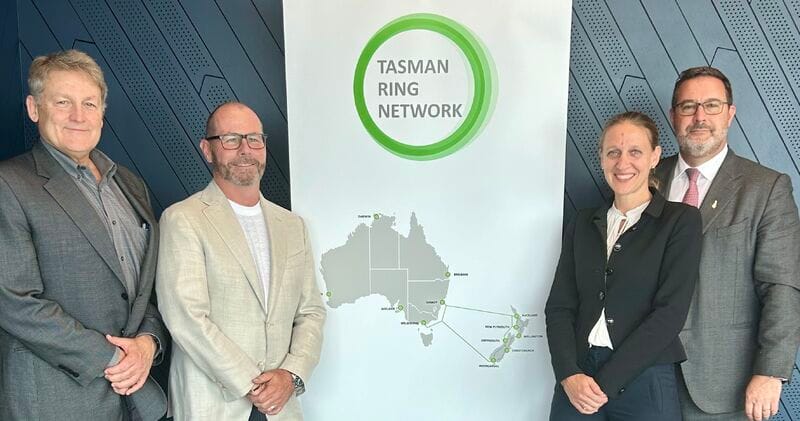
Reannz broadens scope in 20th year
The annual report from New Zealand’s government controlled higher education and research network Reannz highlighted the organisation’s expanded scope. During the year Reannz integrated New Zealand eScience Infrastructure.
That move expanded the organisation’s staff count from 34 to 56 while significantly broadening its mandate which now includes high-performance computing and eResearch services. The change is a response to a ministerial request to create a more dynamic science, innovation and technology system.
During the year Invercargill Airport became New Zealand's first airport to adopt eduroam and Primo in Taranaki became the first wireless internet service provider to deploy the service. Eduroam is an international WiFi roaming service giving students, researchers and staff secure internet access when visiting other participating institutions.
Spark to sell Scopious IoT
Spark is to sell Scopious’ IoT device management software and industry-specific LoRaWAN services. The deal expands Spark’s IoT reach and aims to speed up deployments. Scopious provides templated tools for sectors across New Zealand and the Pacific, adding to Spark’s existing network of almost 2.5 million connected devices.
By 2028, 90% of Tier 1 telco providers will merge their AI strategy with their organisation strategy; AI-related security incidents for telcos will increase by 60% compared to 2025 due to a lack of effective governance and agentic AI will manage 30% of telco operational processes.
— Gartner Insight.
IDC forecasts international phone market set to grow 1.5%
With most of the year’s handset shipment data now collected, IDC forecasts the international market will grow 1.5% in 2025. Much of the impetus comes from record iPhone sales. Apple is set to ship a total of 247.4 million units this year, that’s a year-on-year growth rate of 6.1%.
Nabila Popal, senior research director with IDC's Worldwide Quarterly Mobile Phone Tracker says the iPhone 17 has enjoyed “phenomenal success”. It has done especially well in China, which is a key phone market.
The research company says there will be a ‘soft decline’ in 2026 with the ongoing global memory shortage expected to have an impact on low-to-mid range Android devices which are price sensitive.
Counterpoint forecasts foldable mobile breakout next year
Counterpoint Research says foldable phone shipments grew 14% in the third quarter of 2025. They are now at record high levels. Much of the growth comes from Samsung’s Galaxy Z7 range.
Foldables now account for 2.5% of all handset sales.
The research company says the market will “enter a more pronounced expansion phase” in 2026 with Apple expected to enter the market in the second half of the year.
This time last year Chorus teamed with Datagrid for the Tasman Ring project
Chorus and DataGrid talked about plans for the 6,000km trans-Tasman submarine cable network with a planned capacity of 540 Tbps. There’s an update to this story earlier in this edition of Download Weekly.
Five years ago Sophie Moloney took over the reins at Sky Network Television Limited.
Download Weekly is a New Zealand telecommunications industry newsletter. You are welcome to pass it on to your friends and colleagues. Although the newsletter is free, reader support helps enormously. If you’re reading this for work, donations are tax-free.
Have your say. Sign up as a subscriber to comment on any of the stories on this site. We don’t collect any personal data other than an email address.
Member discussion