
Analysis: Streaming ain’t what it used to be
Streaming and fast broadband are inseparable
New Zealand’s ultrafast broadband arrived just in time for the worldwide streaming video revolution. The government-supported UFB network build started in late 2011, Netflix officially opened for business in New Zealand in March 2015. By then, early adopters were buying services from overseas.
You could flip that formula and say streaming video arrived just in time to ensure the success of the UFB network. When the network was planned in 2009 officials expected around 20 percent of connected homes would eventually sign up for services.
At the time Netflix officially started in New Zealand, only 10 percent of homes passed by fibre were using the service. By 2018, as the first phase of the network build neared completion, uptake hit 44 percent. This was far beyond the initial target and gave government and fibre companies the confidence to extend the network further into regional New Zealand.
The jump from 10 percent to 44 percent took just three years.
Infrastructure as a catalyst
Netflix’s arrival was not the only clear link between streaming and fibre uptake. There were three points where fibre uptake accelerated. The first was after the launch of local streaming services like Telecom NZ’s (now Spark) Lightbox. The growth line took a sharper upward tick after Netflix arrived. By the time Spark Sport streamed the 2019 Rugby World Cup more than half of homes on the network were using fibre.
In hindsight, the 2019 Rugby World Cup was a pivotal moment in New Zealand telecommunications history. It stress-tested the freshly built network architecture and it forced ISPs and Chorus to rapidly optimise peering arrangements and content delivery networks (CDNs) to handle massive, simultaneous live traffic peaks. This proved its worth the following year as the nation went into lockdown in the early stage of the Covid-19 pandemic.
The golden age of streaming
The years from 2015 to the early 2020s were a golden age of streaming. Telcos like Spark used cheap, ad-free streaming as a carrot to sell fibre broadband. Netflix offered a huge content library at a price well below what families spent at video rental stores. Spark Sport offered a wide range of sporting codes and tournaments for less than NZ$20 a month.
Streaming did so well that for a time it looked as if video and music piracy was finally defeated. Why steal when great legitimate content could be had for $15 a month?
Then the economic model changed. Today the streaming landscape is fragmented, expensive and hard for consumers to navigate.
Nothing illustrates what has happened better than the streaming sport sector.
Streaming case study: Sport
Earlier this week the Guardian newspaper reported: Arsenal v PSG got 16.2m illegal stream views in UK after not being free-to-air. This is a significant data point, around one in four views was illegal: copyright piracy is back.
The circumstances are slightly different to the past experience of New Zealand fans who have had little option beyond pay-tv to get their sporting fix. For the last 34 years, the Champions League final has aired in the UK in a free-to-air format.
Yet we are about to see something similar here. TVNZ, which has always been a free-to-air channel, has taken a different strategy with the 2026 World Cup. There will be free-to-air games, but the bulk of the tournament, 82 games, will be behind a $45 paywall.
This is a huge gamble on TVNZ’s part. The Guardian story suggests that when you switch off free-to-air access, consumers don't automatically get out their credit cards: they switch to piracy in droves.
A fragmented pitch
Despite the All Whites taking part in the 2026 World Cup, football is not the obvious sporting code to focus on in a New Zealand context. It is the nation’s fifth or sixth favourite game.
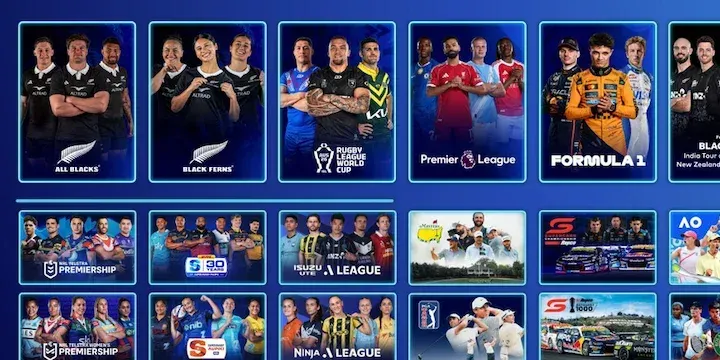
Yet it was football that kicked off streaming sport in New Zealand and has pioneered the market ever since. The first major streaming sports operation here was when Coliseum Sports Media streamed the English Premier League. A year’s subscription cost NZ$150.
This service became the mainstay of Spark Sport before it acquired the 2019 Rugby World Cup rights.
By the time of the 2021-2022 European football season, Spark Sport offered both the English Premier League and the UEFA Competitions: Champions League, Europa League and the newly formed Conference League. Spark also had the rights to the English women's top tier and to domestic New Zealand cricket.
Incredibly good value
The price for this package was $25 a month or $20 a month if you were a Spark mobile or broadband customer. By today’s standards it was incredibly good value.
Comparing the golden age of Spark Sport to the 2026 scene illustrates the point made earlier about modern streaming being fragmented, expensive and consumer-hostile.
Today Sky owns the rights to the English Premier League. While there is a wealth of other sport on Sky, a football fan needs to pay $65 a month to follow their team in the league. DAZN owns the rights to the UEFA competitions, a further $17 a month.
Last year DAZN streamed the World Club Cup competition. To watch the FA Cup you need to subscribe to beIN Sports which costs $15 a month. This also includes Carabao Cup games. Annual subscriptions can work out cheaper in some cases.
Many, but certainly not all, international tournaments show on Sky while TVNZ has previously shown some All Whites games on free-to-air. This year’s World Cup is behind a $45 pay wall.
So in 2026 a football fan has to navigate four streaming services and, if they choose everything, pay well over $1000.
| Service | Cost (Monthly) | Key Football Properties (NZ 2026) |
|---|---|---|
| Sky Sport Now | $59.99 – $64.99 | English Premier League, A-League |
| TVNZ+ (World Cup Pass) | $45.00 (Tournament) | FIFA World Cup 2026 (82 premium games) |
| DAZN | $17.00 | UEFA Champions, Europa, & Conference Leagues |
| beIN Sports | $15.00 | FA Cup, Carabao Cup |
Double dipping
When sports streaming started in New Zealand, the games were shown ad-free. This was also true of services like Netflix or Amazon Prime Video. Today that’s not the case, entertainment streamers generally offer lower priced ‘advertising supported’ tiers.
This is not an option with the sports streamers. Services like Sky Sport Now and DAZN are aggressively double-dipping. They manage to extract inflated subscription fees while simultaneously forcing users to watch live, unskippable, highly repetitive localised ads.
Sky Sport Now costs $59.99 a month. That already makes it one of the most expensive streaming apps anywhere in the world and yet you are still force-fed advertising.
DAZN shows the trend
A DAZN subscription may cost less, but its advertising is considerably worse to the point where it becomes an unpleasant user experience.
When DAZN first launched internationally, its marketing slogan described it as "The Netflix of Sports”. The promise was a flat, affordable monthly fee for premium sports without ads or hidden paywalls.
That did not last. Once DAZN locked down exclusive rights to premier properties like the UEFA Champions League or, for Americans, the NFL Game Pass, prices were systematically cranked up. At the same time they introduced unskippable advertising and started hiding the biggest events behind an additional Pay-Per-View (PPV) wall.
Compulsory combat sport promotions
DAZN's primary business is now about selling boxing and MMA. These are expensive pay-per-view channels, where viewers are expected to pay a further $50 or so per programme. The app’s user interface acts as an aggressive, unavoidable billboard for combat sports.
That’s bad enough, but if the streaming halts, viewers have to log in again and sit through the ads once more before rejoining the entertainment. This is jarring for a New Zealander logging on in the wee small hours to see an Arsenal or Chelsea European match.
Another irritant is that streamers know far more about their viewers than traditional broadcast TV, so can more tightly target advertising. There’s a trope in the industry that says viewers are happier to see targeted, relevant ads. However, providers have such a limited ad inventory that New Zealand viewers can be subjected to the same two or three commercials over and over... even in the same break.
DAZN represents the absolute worst impulses of the modern streaming era: it behaves like a free, ad-supported app in terms of its visual clutter and commercial frequency, but charges you like a premium service. Football fans only tolerate this because they have no other legal choice if they want to watch the Champions League.
It’s all about ARPU
Part of what is going on here applies equally to all streaming services. Like telcos, the business metric that matters is ARPU or Average Revenue Per User. When it comes to entertainment streaming, you can buy your way out of the advertising. An additional payment of around $10 a month buys an ad-free entertainment service.
In the streaming world, an ad-supported user is often more valuable to the company than a standard subscriber.
If a streaming service costs $50 a month, the streamer’s revenue from you is $50. But if they charge you $40 a month and make $15 a month by showing you ads, their total revenue from you jumps to $55.
Streaming sport is different
Sport is different from entertainment for three reasons. First, live sport is only live once. Yes, being able to watch on demand is popular especially for New Zealand football fans wanting to see games that kick off at 3am local time and still being able to work the next day. But for big games, live is vital.
Because viewers watch live sport in real-time, they can’t skip the half-time ad break.
Second, there are no substitutes. If your entertainment streaming service doesn’t offer your favourite show, there will be suitable alternatives. That’s not the case with football. A Manchester City fan won’t be satisfied making do with the New York Yankees.
A lucrative demographic
Also, sports fans skew heavily toward the passionate, high-spending demographics that advertisers crave.
By refusing to offer a premium, ad-free tier for sports, streaming companies are keeping that extra "ad value" for themselves.
For Sky to earn the same revenue from a truly ad-free version of Sky Sport where the commercial breaks were replaced with highlight clips, that $60 a month subscription fee would need to be closer to $75 to make up for the lost ad revenue. While exact figures vary, the ad-free price point would inevitably trigger subscriber cancellations.
The squeezed middle
Before we move on, it’s worth pointing out that despite selling one of the world’s most expensive monthly streaming subscriptions, Sky TV is not hugely profitable. The company had a net profit margin of 2.7 percent for the 2025 financial year. There were one-off costs, but the adjusted figure of 5.4 percent is still modest for a business that has a near-monopoly in its core market.
That’s because the company is caught in a pincer. On one side of the pincer it has to buy content from international sports bodies like NZ Rugby, Sanzaar or the Premier League and it is up against competitors with deep pockets.
Among others, Amazon, Apple and Netflix have all been buying sports rights. These artificially inflate the prices charged by sporting bodies. Most of the value in streaming sport ends up with the sports cartels.
The other side of the pincer is that Sky has to claw back its revenue from a population of just over 5 million. If we go back to the example of the Arsenal v PSG Champions League final, UK viewers pay around NZ$10 a month for a subscription to the relevant service. Spreading the costs over a population of 55 million makes that more possible.
General entertainment now fragmented
Entertainment streaming is going through similar changes that are just as aggressive and consumer hostile. The market continues to fragment. Where you might have once bought one or two subscriptions to cover all your entertainment needs, you now either need to pay for multiple subscriptions or flit between services opening new ones and cancelling old ones on a regular basis.
Aside from the extra expense of additional subscriptions and the administrative overhead of managing multiple accounts, it also gives users the job of stitching together entertainment bundles.
The arrival of HBO Max in the New Zealand market parallels what has happened in streaming sport. Global giants like Warner Bros Discovery now operate direct to consumer channels. They have stopped content from local aggregators like Sky with its Neon streaming service.
No more all-in-one
Just as football fans now have to manage and pay for a raft of channels to watch what was once part of an all-in-one service on Spark Sport, viewers seeking streaming entertainment face increased costs and complexity.
Data from companies like Roy Morgan show that while Netflix remains the favourite of New Zealand households with around 2.2 million regular viewers, the rest of the market has commoditised. It has all been designed to squeeze more and more ARPU from an exhausted base of consumers.
| Platform Category | NZ Market Examples | Can You Pay to Escape Ads? | How the Platform "Double-Dips" |
|---|---|---|---|
| Premium Live Sport | Sky Sport Now, DAZN | NO | Charges the highest entry fees on the market, but keeps ads because live commercial blocks are a captive goldmine. |
| Global Entertainment | Netflix, Disney+ | YES (Via Premium Tiers) | Introduces cheap, heavily tracking "With Ads" tiers to lure low budgets, while charging massive premiums for ad-free 4K. |
| Tech Giants | Amazon Prime Video, YouTube | YES (Via paid upgrade) | Injects ads into standard plans by default (Prime) or makes the free experience heavily disrupted (YouTube) to force a paid upgrade. |
| Local Free-to-Air | TVNZ+, ThreeNow | NO | Costs $0 to watch standard TV, relying entirely on heavy digital video ads to survive the collapse of traditional TV ad revenue. |
International loss-leader strategy
Big tech firms have distorted sports markets overseas. Netflix has the rights to some of America’s NFL games and Apple has Major League Soccer rights. They treat sport as a loss leader for other properties. Apple gets to sell more iPhones and drive up its subscription business, a tail that is starting to wag the dog. Amazon uses sport a lure for its Prime shipping business. In both cases these are ecosystem plays.
While this breaks the traditional market, local providers like Sky TV or TVNZ cannot compete on those terms because video content is their entire business, not a strategy to grow other parallel corporate operations.
We have been here before. In the mid-2010s, telecommunications companies faced the threat of commoditisation. This was true around the world, but the Telecom NZ demerger that gave us Chorus and Spark made this particularly acute in New Zealand. Fibre broadband became a commodity, every telco sold the same product. To compete on price, Spark would need to compromise its profit margins.
Spark looked at its main rival Vodafone (now One NZ), which was getting ever closer to Sky TV. At one time the two attempted a merger. Vodafone had its own TV product and offered bundled packages with Sky. This gave the company a point of differentiation in what was becoming a commodity market.
Sport could give Spark a better edge, sports enthusiasts are more of a premium market than general TV viewers. It realised it could use the Rugby World Cup and English Premier League rights as an aggressive customer-acquisition tool. If you want to watch Rugby or football for free, all you had to do was switch your fibre or mobile plan to Spark. It was a loss leader that broke Spark out of the commodity trap.
In Australia, Optus outbid Fox Sports for the English Premier League rights. They explicitly forced customers to sign up for Optus broadband or mobile contracts to access the games. Telstra did the same with AFL and NRL streaming rights.
Geographic scale has its limits
This strategy looked good until American tech giants with deeper pockets faced similar commoditisation traps. The price of sports rights ramped up faster than any growth in broadband or mobile subscriptions could sustain. This reached the point where the cost of those rights threatened the very profits the telcos had been protecting with their forays in streaming sport.
Digital is all about scale. New Zealand’s population of five million can’t scale enough to justify the cost of sports rights. Even Australia’s 26 million is not big enough. Apple, Amazon and Netflix have billions of potential customers in their sights.
That model has since been turned on its head. In the golden age of streaming telcos like Spark, Telstra and British Telecom gave away streaming to sell premium fibre or mobile subscriptions. The exact same playbook is now being used by tech giants. While there is no reason to suspect they will be more successful, their activity will change the market.
Today, that has reversed, Sky TV now sells broadband to its customer base. This is an attempt to capture more margin and, once again, raise ARPU across the business. With content margins being squeezed by overseas market changes, Sky can recover ARPU by selling the connection.
It all goes round in circles
The telecommunications sector spent the last decade using the unbundled allure of cheap, ad-free streaming to justify and accelerate New Zealand’s world-class UFB deployment. The network succeeded beyond the wildest projections of its initial planners, creating a national utility that quite literally kept the economic wheels turning during global lockdowns.
But the media ecosystem that flourished across that fibre infrastructure has grown into an increasingly fragmented, difficult to navigate and expensive landscape.
When subscription fees skyrocket, platforms double-dip by inserting unskippable ads into premium tiers, and content is aggressively siloed into independent corporate vaults, consumers do not infinitely divide their wallets. They reach a hard financial limit.
The massive spike in worldwide digital piracy, exemplified by the millions who turned to illicit feeds for the Champions League Final, may be a consumer response to a deeply broken user experience.
By pushing their growth strategies and chasing higher ARPU past the point of friction, media giants have inadvertently built a thriving parallel market for illegal IPTV services that run seamlessly across fibre networks like the one New Zealand built.
Liberation
The digital streaming revolution promised liberation from the bloated, expensive, one-size-fits-all pay-TV legacy. A decade later, faced with a fragmented array of services that collectively cost far more than cable ever did while serving the exact same commercial interruptions, consumers are exhausted.
One possible development is for the fragmented parts to reconsolidate. For aggregators to emerge. What an irony we face. It is possible that after ten to 15 years of turmoil, we’ll end up with a video media landscape that closely resembles the model we had before any fibre was laid.
The difference is that the moving images on our screens that once beamed through the airwaves will be delivered over fibre and fixed wireless broadband technologies by internet protocol.
Other recent analysis posts:
Member discussion