
Cell site batteries, private 5G, refurbished phones

In this edition:
- National Infrastructure Funding and Financing money for cell site resilience
- Spark and Ericsson build private 5G network
- One NZ runs second hand phone pilot
- New Zealand top user of satellite direct-to-device
Government funds Spark tower battery upgrades
National Infrastructure Funding and Financing (NIFF) has awarded Spark a contract to upgrade battery back-up capacity at 295 cell towers. The upgrades mean towers will have 24 hours of battery back-up in the event of a power outage.
Spark is working with Connexa, which acquired the telco’s mobile tower network in 2022. Connexa also owns the towers formerly owned by 2degrees.
The upgrades will start later in 2026 and are expected to be completed by June 2027.
Connexa, Spark and the government are co-funding the increased battery capacity. Of the $6.4 million allocated by the government to this fund, $4 million has been contracted to support the upgrades for the 295 sites.
Access during long outages
Mike Paranihi, Spark’s general manager of network and operations, says: “Extending battery back-up will enable over a million Spark customers to have access to mobile data, text and calls during prolonged outages.”
He says in a power disruption people living at as many as 1.7 million addresses will be able to call 111 regardless of their telco provider.
National Infrastructure Funding and Financing (NIFF) is a government agency that connects private capital investments to public infrastructure projects. NIFF traces its origins back to Crown Fibre Holdings, which oversaw the UFB rollout before becoming Crown Infrastructure Partners and, in 2024, NIFF
The increased battery capacity is co-funded by Connexa, Spark and the government. Of the $6.4 million allocated by the government to this fund, $4 million has been contracted to support the upgrades for the 295 sites.
Background:
 Bill Bennett
Port Nelson replaces WiFi with private 5G
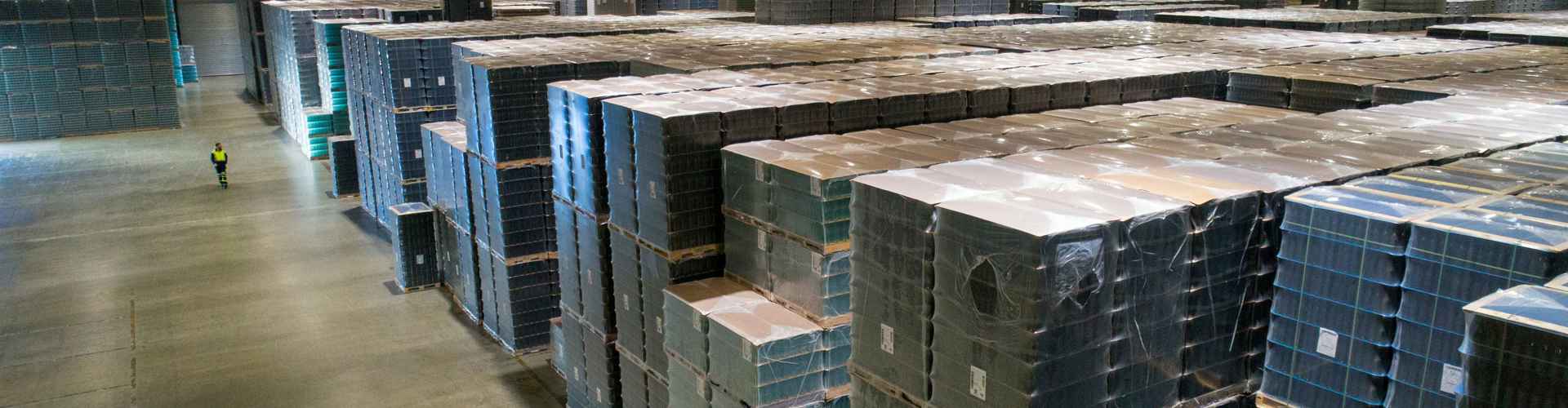
Port Nelson replaced its unreliable warehouse WiFi with a private 5G network built by Spark and Ericsson. The new network improves pallet scanning, improvements to productivity and safety. It also opens the door for future automation.
Spark’s 5G private network covers around 30,000 square metres across three warehouses in Nelson and Blenheim and uses Ericsson Private 5G. There is a core at Port Nelson that connects to small cell radios.
That’s important because the Port’s complex design and the high‑density block‑stacking storage used in the warehouses meant there were persistent dead spots in the WiFi network that was previously in use. Staff were forced to change operating processes to maintain connectivity.
The Port uses Ericsson Cradlepoint ruggedised R1900 routers for forklift connectivity and tracking. These have dual-SIM capability, which lets them switch between Spark’s public and private 5G networks when forklifts move outside the private 5G coverage areas.
Connectivity as a constraint
Reagan Pattison, Port Nelson’s general manager business transformation, says connectivity was becoming an operational constraint. “No matter how much we tried to saturate our warehouses with WiFi, we couldn’t get consistent performance. That impacted productivity, created frustration for our operators, and limited our ability to modernise how we work.”
In contrast, private 5G offers predictable performance and pervasive coverage. It means staff can scan pallets in real time without interruption. It also gives improved visibility into performance so issues can be identified and fixed.
There’s push-to-talk communications which helps with health and safety. Location-based alerts can warn people about vehicle movements.
In a statement, Spark says the private 5G network could support future applications such as real‑time asset tracking, predictive maintenance, enhanced CCTV cameras, AI‑enabled vision and automation.
One NZ to sell refurbished phones
One New Zealand is now running a pilot programme selling refurbished mobile phones. The phones have been tested, cleaned and restored to what One calls excellent condition. This means no cracks, dents or heavy wear and at least 80 percent battery health.
The phones are sold with a 24-month warranty and at a discount to new price giving consumers a lower cost route to upgrading their handsets.
While the cost savings are important, One NZ’s focus is more on the sustainability aspects of refurbishing previously used hardware.
The company says a refurbished phone can cut emissions by up to 49 percent when compared to buying a new phone. That’s about 34 kg of CO₂e for each phone.
Nicky Preston, One NZ’s head of sustainability and corporate affairs says: “Keeping devices in play for longer is a practical way to avoid emissions and save people money at the same time.”
At the time of writing One has iPhone 12, 13, 14 Pro and 15 Pro models. The telco says it expects to add more models as the programme expands.
One NZ has a phone trade-in programme which lets customers use the value of their existing phone towards the cost of a new one.
Preston says One NZ is already seeing strong demand from customers wanting to trade-in old phones. “Selling refurbished phones is the next step in our circularity journey, making it easier for those devices to find a second life, and for more people to access high-quality phones at a lower price.”
In other news...
- Fibre, fixed wireless, satellites and rural connectivity — NZ Tech Podcast
Hear me on the NZ Tech Podcast with Paul Spain talking about rural connectivity and other topics. - What screen time does to children’s brains — NZ Herald (paywall)
Results from Auckland University study show harm is real. - SpaceX files for IPO — BBC
Business valued at US$1.25 trillion.
New Zealand leads direct-to-device league table
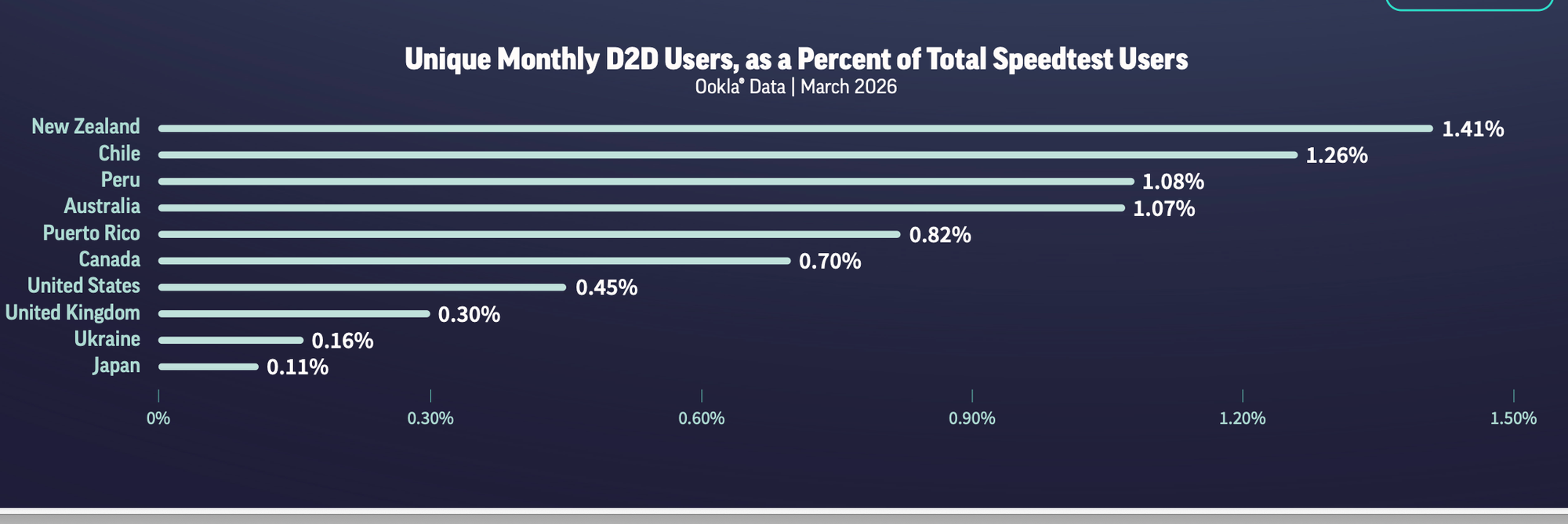
Speedtest data suggests New Zealand is the world’s most enthusiastic user of satellite direct-to-device or D2D services. D2D is the technology that allows ordinary mobile phones to connect to satellite networks. For now, the services only support messaging and limited data applications.
The table compares the proportion of all Speedtest users using D2D services, which may not be an accurate measure of usage, but in the absence of other data is a useful proxy. The proportion of New Zealanders connecting through D2D is 1.41 percent. Chile is in second place with 1.26 percent, while Australia is 1.07 percent.
One NZ wins cloud innovation award
Red Hat named One New Zealand as a winner in its annual innovation awards. The prize is for One NZ’s work to modernise its telecommunications cloud infrastructure. This brings together a series of formerly fragmented systems in a single cloud. One NZ says it can reduce costs and bring new services to market faster..
This time last year: Chorus boosts business fibre
Chorus refreshed its business fibre portfolio with a range of upgrades including a 1 Gbps symmetrical plan. Also in the edition are OECD stats showing New Zealand is third in the world for fixed wireless broadband adoption.
Five years ago 2degrees was preparing for an IPO 2degrees reported service revenue of $545 million for the 2020 financial year as parent company, Toronto-listed Trilogy International said it was preparing to list 2degrees.
Ten years ago the RCG completed the first stage of its rural network build ahead of deadline delivering wireless broadband to 300,000 homes.
Download Weekly is a New Zealand telecommunications industry newsletter. You are welcome to pass it on to your friends and colleagues. While the newsletter is free, reader support helps enormously. If you’re reading this for work, donations are tax-free. A banner at the top of the page will take you to the support site.
Have your say. Sign up as a subscriber, it is free, to comment on any of the stories on this site. We don’t collect any personal data other than an email address.
Member discussion