
Copper price trims Chorus profit, dividend returns
Chorus posted a lower profit for 2015. In a statement chief executive Mark Ratcliffe said the fall was due to a cut in regulated unbundled bitstream access (UBA) and unbundled copper local loop (UCLL) prices.
What he didn’t say is the numbers could have been much worse. The company dodged a bullet, maybe more than one, when the Commerce Commission ruled to cut the Unbundled Bitstream Access (UBA) fee by less than its initial draft price.
Even with a higher regulated price the company suffered. In the last six months of 2015 Chorus made an after-tax profit of $33 million. That’s almost half the $64 million made in the same period a year earlier.
Chorus owns the local copper network and sells wholesale access to internet service providers like Spark, Vodafone and CallPlus. The UBA and UCLL prices it can charge are regulated by the Commerce Commission.
Three years of copper wrangling
It took almost three years of wrangling to decide the regulated UBA and UCLL prices. Most observers and analysts regard the final December 2015 ruling as a Chorus win, although that's not how the company spins it.
The December 2014 interim ruling set prices higher than initially proposed, providing some relief, but the December 2015 final decision increased them further, creating today's mixed financial picture.
While this was taking place Chorus suspended dividend payments to shareholders. With the new price in place these have resumed.
The company says it expects to pay a dividend of 20 cents per share for 2016. There will be an interim payment of 8 cents in April.
Investors seem pleased. Chorus shares were up almost five percent immediately after the announcement.
In a letter to shareholders chairman Patrick Strange noted two other highlights:
Ultra-fast Broadband (UFB) build is now complete for 48% of planned premises, including seven towns, and the Rural Broadband Initiative (RBI) rollout is almost complete. These programmes have now brought better broadband within reach of about 646,000 consumers nationwide.
Demand for fibre continues to increase and more than 112,000 mass market consumers have now been connected to fibre services. Growing numbers are opting for a 100Mbps service or better.
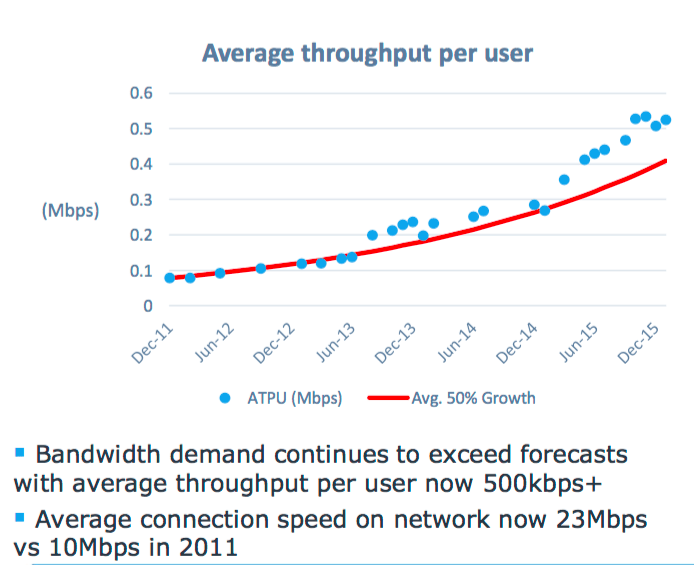
A slide in the results presentation shows how fixed line connections are moving fast from copper to fibre. Meanwhile, the average throughput per user is climbing at a rapid rate.
Despite these challenges, the UFB build reached 60% completion with strong customer uptake by February 2016, showing the project is succeeding.
 Bill Bennett
Member discussion