End in sight for mobile termination regulation

In this edition:
- ComCom to drop MTAS regulation
- Chorus product to bridge digital divide
- Fibre rules to be updated
- RCG moves beyond plugging remote coverage gaps
Stronger mobile market paves way to drop termination rules
The Commerce Commission has sent a recommendation to the Minister for Media and Communications that mobile termination rules can be removed.
It says New Zealand’s mobile market is now strong enough that the regulations are no longer required.
Mobile Termination Access Service or MTAS allows voice calls and text messages to move between different networks. Termination rates are the charges made when a call starts on one network and finishes on another.
Until 2010, the two main mobile networks were Telecom and Vodafone, now Spark and One NZ. They used high termination rates along with price incentives for customers to stay on their existing network to create a structural disadvantage making it hard for 2degrees, then a new entrant, to compete. At the time, Tuanz warned the market could return to a duopoly.
Level playing field
Under the Telecommunications Act, certain telecom services can be designated for regulation if competition is weak or barriers to entry exist.
By stepping in and regulating MTAS in 2010, the Commerce Commission created a more level playing field which, over time, allowed 2degrees to become a strong third mobile network. This in turn led to today’s competitive mobile market.
MTAS were added to the Telecommunications Act’s regulated services schedule, which means the Commission can set wholesale pricing and access terms to address competition issues.
Telecommunications commissioner Tristan Gilbertson says: “With competition now well established between three national providers, regulation has done its job and can step back.”
While, formally, the next step is the minister’s decision, it is unlikely he would ignore the recommendation.
User advocate responds
Tuanz CEO Craig Young says his organisation is disappointed with the decision “...after the hard work that went in over many years that led to the original inclusion in the Act”.
He says while the Commission has rightly pointed out that the market is significantly different now with a strong third player: “By removing the service from the schedule, this lessens the threat of regulation if the market fails.
“It is this threat that often provides enough warning to the market to operate competitively and the removal could be detrimental to users.
“We recognise that the Commission will maintain a monitoring watch and we will also take a much closer interest in how the market develops if the recommendation is accepted by the Minister.”
When the Commerce Commission published its draft decision on MTAS regulation in November, it was supported by Spark and One NZ, but there were objections from companies who felt it created risks for smaller players in the market. See: Wholesale telcos oppose mobile termination deregulation
Chorus caps Equity Fibre at $30 to help close digital divide
Chorus has launched the Equity Fibre 100 wholesale plan signalled by CEO Mark Aue at the company’s recent half year result call.
Equity Fibre 100’s retail price is capped at $30 a month and is specifically for low-income households. The download speed is 100 Mbps, uploads are 20 Mbps.
The product launches as an estimated 400,000 households are unable to afford a broadband connection.
Chorus says Equity Fibre 100 is “designed to support low-income households in public or community housing or lower-decile school communities who have an inactive fibre connection, and who can show eligibility through a Community Services Card or MSD benefit letter”.
Four retailers now, more coming
Households who may qualify are encouraged to contact participating retailers. For now these retailers are: Fusion, Vetta, Prodigi and InTune. Chorus says more are preparing to offer the service in coming weeks.
Ken Walliss, Chorus’ executive general manager for Access, says: "We have been deliberate about the retail price cap to keep this accessible. Independent research by Digital Equity Coalition Aotearoa (DECA) has identified $30 a month as realistically sustainable for eligible families.
Regulator revisits five-year-old fibre rules
The Commerce Commission’s continuing telecommunications regulation update has moved on to its first review of Fibre Input Methodologies.
These are a set of rules under the Telecommunications Act 2001 that determine how fibre assets are valued, how prices and revenues are decided and how the cost of capital is calculated.
Like other telecommunications regulations, the Commission is required to regularly review the rules.
In the draft decision, it proposes what it describes as a “clearer investment test for large fibre network expansion projects”.
Telecommunications commissioner Tristan Gilbertson says: “Our job is to make sure the rules support ongoing investment in world-class fibre networks and services that are critical to New Zealand’s digital economy.
Rules are working
“The core rules for fibre networks are working well. This review focuses on targeted improvements to simplify and streamline the framework, so it remains fit for purpose as the market evolves.
“Setting out the framework up front reduces uncertainty and helps ensure Chorus can invest to expand its network where there’s a sound case.
The Commission’s proposal would see large expansion projects assessed using a cost-benefit framework, including measures such as consumer willingness to pay for fibre services.
It also proposes changes to capital expenditure processes, including clearer information requirements and adjustments to regulatory timelines, aimed at increasing industry predictability.
A second stage will look at issues including cost of capital, ahead of the next price-quality reset due in 2029. Fibre regulation has a long and complex history. At one point it threatened to sink the emerging technology.
Submissions on the draft decision close in April, with a final decision expected later this year.
RCG extends brief with iConn in-building coverage
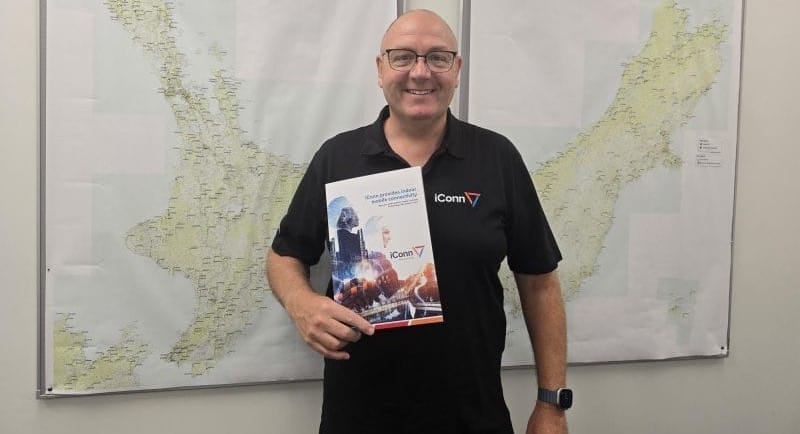
The launch of an in-building mobile coverage product aimed at large commercial and industrial sites moves the Rural Connectivity Group beyond its original brief of filling network gaps in country areas.
The system, known as iConn, uses Distributed Antenna System (DAS) to improve indoor signal in locations where construction materials or scale limit coverage. The system extends RCG's shared model to enterprise environments, supporting multiple operators.
RCG says the approach builds on its multi-operator radio access network, which is used by Spark New Zealand, One New Zealand and 2degrees.
The move reflects rising demand for consistent indoor connectivity as mobile traffic shifts further inside offices, retail sites and public buildings.
In other news...
- Datagrid’s $5.1b Southland data centre — NZ Herald (paywalled)
What are the remaining hurdles? - [Networks on autopilot] — Opensignal Insights
Can networks think, adapt and act for themselves? - AI behind component shortage — RNZ
Phones, laptops and anything digital will cost more. - Social media is harming children — Newsroom
The evidence is in.

Election mandate to feature at Tuanz Connecting Aotearoa Summit
‘Developing a universal connectivity roadmap ahead of the 2026 election’ will be a key theme at this year’s Connecting Aotearoa Summit. Fittingly, the event will take place in Wellington’s Parliament Buildings on Wednesday May 13.
Tuanz CEO Craig Young says too many remain left behind at a time when digital connectivity is essential. “Our 2026 Summit brings together policymakers, industry, and community leaders to demand coordinated action and secure cross-party commitment to the 2030 goal."
One year ago:
Commerce Commission says telco protocols need work
A Commerce Commission study found telecommunications customers continue to face barriers if they attempt to switch between service providers.
Almost a third of people wanting to switch found the experience so bad, that it puts them off switching again in the future.
Five years ago:
Broadband use surges, fixed wireless speed drops
Three talking points emerged from the Commerce Commission’s latest Annual Telecommunications Monitoring report.
First, in general, New Zealand’s telecommunications networks were more than up to the job of coping with massively increased demand during Covid pandemic lockdowns.
Second, average download speeds for fixed wireless networks were down 25 percent.
Third, there’s a clear problem with retail telecommunications revenue. This has implications for investment in new networks and technology upgrades.
Ten years ago:
The end of copper: New Zealand retires its old phone network
A decade ago, closing the copper network seemed controversial. Today, with less than 80,000 connections remaining, it's almost done. Here's the 2016 case for copper shutdown, plus the story of what happened next and where we are now in 2026.
Download Weekly is a New Zealand telecommunications industry newsletter. You are welcome to pass it on to your friends and colleagues. While the newsletter is free, reader support helps enormously. If you’re reading this for work, donations are tax-free. A banner at the top of the page that will take you to the support site.
Have your say. Sign up as a subscriber, it is free, to comment on any of the stories on this site. We don’t collect any personal data other than an email address.
Member discussion