
Archive: NetHui 2013 — a key moment in the NZ internet story
The power of the open internet
NetHui 2013 captured the mood on New Zealand’s internet sector at an important turning point.
The term Hui needs some explanation for overseas readers. It is unlike almost every traditional conference, seminar or summit. Hui is a Māori term for a coming together that aims to build understanding and develop a collective commitment.
For NetHui 2013, the event theme was “The power of the open internet" and while many sessions reflected that, there was an underlying tension as the internet community faced off against a government looking to increase surveillance and regulate what had previously been a freewheeling space.
Wide range of debates
There were debates, sometimes acrimonious, about the UFB roll-out, left behind people or areas and the costs imposed on internet services by government regulators. It was a time when many referred to the ‘copper tax’. Behind the scenes government officials and politicians told the industry to stop using that term or ‘there would be consequences’.
Meanwhile, protestors objected to a GCSB bill that appeared to entrench surveillance, even though the New Zealand approach to this turned out to be mild by international standards.
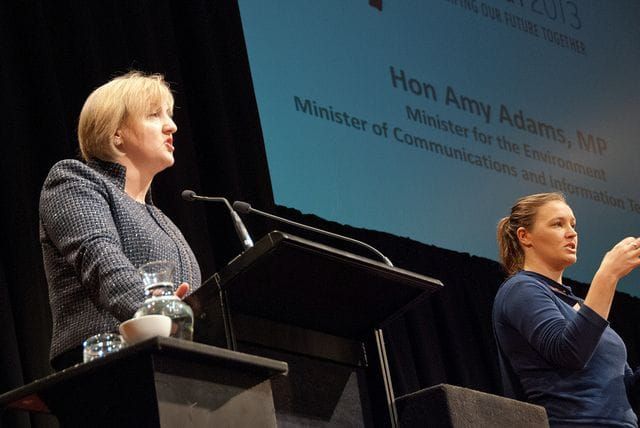
NetHui 2013 was the place the friction between two camps could be examined and understood. On one side, we heard from keynote speaker Quinn Norton who talked about "feral collectives" and the decentralised power of the web. On the other, we had a government represented by communications minister Amy Adams, moving to overhaul rural copper regulations while simultaneously pushing through a contentious GCSB bill.
This post is a wrap of my reporting from that week—covering the political tension, the crisis in digital journalism and the hard lessons we learned about who really wields power in a connected New Zealand.
1. Slime mould and the feral collective
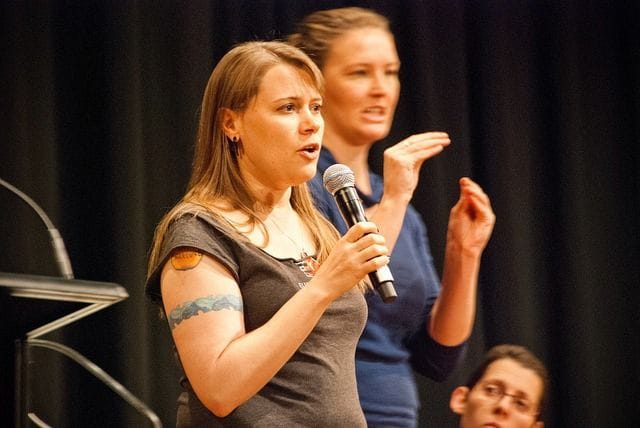
Keynote speaker Quinn Norton provided the philosophical frame for the week, comparing the internet revolution to the arrival of the printing press.
Just as William Tyndale upset the 16th-century establishment by translating the Bible into English, Norton argued that today’s "emergent and feral collective" is fundamentally changing how people relate to government and political leadership.
Norton’s most striking metaphor was describing the internet as the "slime mould of humanity". Much like the leaderless underground networks that find their way out of mazes, she noted that the internet operates as a chaotic but effective networked organism.
Her observation—that an "incompetent networked organism is meeting a competent but confused and powerful system that would just like it to all go away"—summarised the mood of the room perfectly.
2. Legislative tension: GCSB and TSO
While the philosophers were discussing feral collectives, the politicians were focused on the plumbing and the law.
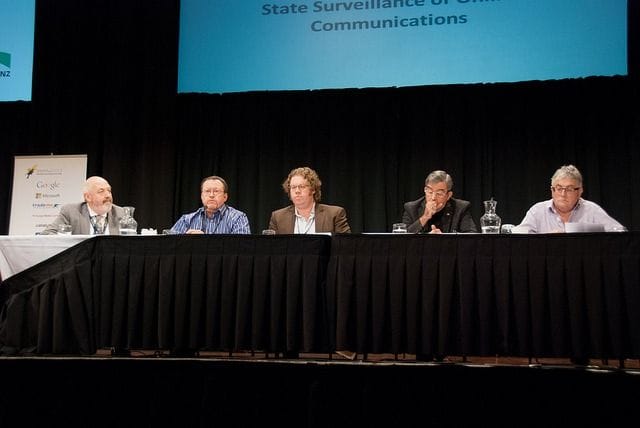
Surveillance showdown
NetHui’s state surveillance panel showed that even the New Zealand establishment was not a monolithic block. Former GCSB director Sir Bruce Ferguson shared insights that suggested the government was out of touch with both popular feeling and the expert security community.
Protesters outside the venue were vocal in their objections to the GCSB Bill, which many felt entrenched a system of routine invasions of privacy just as the Snowden leaks were bringing global surveillance into the light.

Citizens already restrict their own freedoms by participating in loyalty programs and social media.
– Former GCSB director Sir Bruce Fergusson speaking on the NetHui 2013 state surveillance panel
TSO policy update
Amidst the surveillance drama, Communications Minister Amy Adams used her keynote to release a discussion document on possible changes to the Telecommunications Service Obligations (TSO), noting that the 2001 framework had been "frozen in time".
The TSO required Telecom to provide voice and dial-up data at speeds that were laughable by 2013 standards—14.4 kilobits per second at a time the UFB network was promising 100 Mbps.
Adams argued that these legacy obligations were actually stifling innovation and locking in outdated copper technology. It was a moment where the "copper tax" and the transition to fibre became a central, if acrimonious, debate.
3. The trouble with journalism
The crisis in how we tell these stories was also on trial. Between 2006 and 2013, the number of print journalists in New Zealand dropped by 61 per cent, while PR professionals increased to outnumber reporters three-to-one.
This "reconcentration" of media into national digital news services meant that the nuanced, technical debates happening at NetHui were increasingly difficult for traditional newsrooms to cover without falling back on "elite narratives" or authority-skewed myths.
4. Other lessons from NetHui 2013
NetHui is a wide-ranging event, this is list is far from exhaustive, here is one person’s memory of the other key messages.
- We can change the internet: The community realised it wielded the power to influence New Zealand's internet future.
- Privacy is now a mainstream political agenda: People were groping for ways to regain control over their information security.
- The establishment isn't monolithic: Even those inside the security apparatus were questioning the path forward.
- Poorer schools have the most to gain: As Point England principal Russell Burt demonstrated, technology can transform the lives of students at the bottom of the economic heap.
- The future is uncertain (and that's okay): The "feral collective" functions better than expected, even if the "killer apps" for the UFB are yet to be found.
- Recorded music sales have collapsed: Retail sales have largely vanished with the shift away from physical media.
NetHui 2013, the view from 2025
Looking back, 2013 was the year the "Open Internet" began to grow up. The "slime mould" found its way out of the maze of 2013. Many of the issues, from rural connectivity to state surveillance, remain at the heart of the New Zealand tech story. Indeed, rural connectivity, and to a lesser degree the related problem with the digital divide, is the most pressing remaining political challenge concerning communications.
The TSO review eventually paved the way for the copper retirement we are seeing today, and the "feral collectives" Norton spoke of have evolved into the complex web of social media services we have to navigate, some might say tolerate, in 2025.
Three busy days, a total of 65 sessions and hundreds of conversations meant NetHui gave everyone who took part plenty to think about. It’s an open conference, organisers encourage delegates to participate. That makes it New Zealand’s biggest technology learning experience.
There’s no way to squeeze all the insights into a single, simple blog post. However a few big themes emerged:
Member discussion