
Mobile plan transparency going backwards
Spark, 2degrees cut consumer information
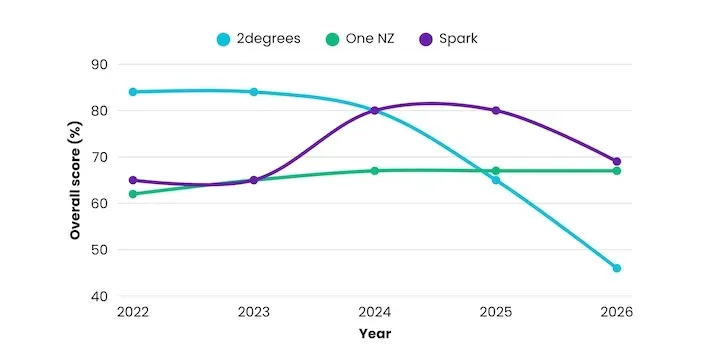
Consumer NZ’s 2026 review shows a significant decline in mobile transparency at Spark and 2degrees. While One New Zealand did not go backwards, nor did it improve.
Nick Gelling, the Consumer NZ journalist behind the mobile transparency review, wrote: “This year’s results are the worst we’ve seen in five years of the review.” As noted in our "This time last year" section, 2025 was equally poor.
The review is conducted with the Commerce Commission, which published its Mobile Transparency Guidelines in November 2025.
Spark’s transparency performance plummets
In the review Spark’s overall rating dropped from 80 percent to 69 percent. The Consumer NZ review regards Spark’s mobile app as excellent, rating it at 85 percent. Yet the score for Spark’s annual email summary fell from 72 percent to 46 percent. The email now mainly prompts customers to open the app instead of providing any useful information.
If anything, 2degrees fared worse with its overall score dropping from 65 percent to 46 percent. The company sent no usage summaries to customers between July 2025 and July 2026 due to IT platform issues. For that reason it earned a zero score in that category.
Consumer says the company’s app has improved, but customers can only get daily usage figures.
In the early years of Consumer NZ’s transparency review, 2degrees was the clear leader. It now lags its rivals. However, Consumer NZ notes that next year’s result will be better when the email summary is restored.
One NZ remained unchanged in second place with an overall score of 67 percent. Its annual summary email is now the only one meeting most guidelines, but its app still only shows two to three months of historical data instead of the 12 months recommended by the Commerce Commission.
None of the telcos provides information to help low-use customers find better value plans.
2degrees-One apply for JV clearance
2degrees and One NZ have filed a 128-page clearance application for their proposed radio access network joint venture, Ranco, with the Commerce Commission. The application argues that radio access network (Ran) assets are essentially homogeneous and not a source of competitive differentiation.
The application, dated September 25, but only made public last week, comes after our August 27 report that the two carriers planned to merge their Ran assets into a jointly owned wholesale business by 2027. Last week we covered the Commission's October 1 statement of preliminary issues identifying unilateral, coordinated and vertical effects as key concerns.
Under the deal, both carriers transfer their Ran assets—antennas, radios, baseband equipment—to Ranco, a 50/50 joint venture. Ranco will own and operate the combined Ran assets and sell managed Ran services back to both parties. Spectrum, core networks, fibre backhaul, satellite assets and cell-site routers remain with the individual carriers.
Ran is just a pipe
The telcos' central argument is that Ran is merely the "pipe" through which services are delivered. "Ran assets are not a source of differentiation between MNOs," the application states. It notes that all New Zealand operators run essentially the same Ericsson, Nokia or Huawei kit. Removing duplication frees capital for spectrum, core network, price and product. These areas are where competition actually occurs.
The application identifies three relevant markets: retail mobile, wholesale mobile and upstream infrastructure services. In each, the parties argue no substantial lessening of competition will occur, citing independent Servcos, continued pressure from Spark and growing MVNO competition, and the ability to deploy Ran unilaterally where the parties disagree.
The Commission plans to test the parties' key argument, that Ran is a homogenous input, by asking suppliers whether 2degrees and One NZ actually compete when buying equipment. It will also ask operators whether Ran assets matter to retail and wholesale competition.
International precedent features heavily in the application, including European Commission guidelines on network sharing and the ACCC's Optus-TPG decision involving Australia’s second and third largest MNOs challenging the market leader.
If cleared, Spark would be the only New Zealand operator running a fully separate national radio network. The parties aim to complete the transaction in the first half of 2027.
MBNZ: Starlink’s slowing 100 Mbps plan
Starlink's "Residential 100 Mbps" plan is significantly slower than its "Residential Max" plan. The Commerce Commission’s October 2026 Measuring Broadband New Zealand report notes the gap between the two plans has widened in the most recent quarter.
It notes that download speeds for Starlink’s $170 Residential Max plan have increased compared to the previous report (July 2026). In July customers on the Residential Max plan saw speeds of 245 Mbps falling to 224 Mbps at peak times. In the October survey period this has increased to 284 Mbps and 253 Mbps at peak times.
All-day speeds for the $85 Residential 100 Mbps, formerly known as the ‘Lite’ plan have fallen from 130 Mbps in the July 2026 report to 97 Mbps in the October 2026 report. Peak speeds dropped from 115 Mbps to 92 Mbps. The gap between the two plans has gone from 115 Mbps to 187 Mbps.
Analysis: Starlink is deliberately throttling its budget satellite broadband plan to protect performance for premium customers.
The company now offers rural New Zealanders three tiers of satellite broadband. A third $125 Residential 200 Mbps plan is listed on the company’s site but is not covered in the MBNZ report.
Differentiating customers by speed tier is standard for urban fibre, but new for rural satellite users.
It was inevitable. As Starlink's network gets busier, it chooses to prioritise higher-tier customers.
Starlink's $85 plan costs more and offers less than Fibre 100, which costs $50-60/month in urban areas. But rural customers do not have a fibre option.
It may come as a surprise to those customers who sign up hoping to see the much-talked-about higher speeds for a low Earth orbit satellite network. Those higher speeds come at a considerable premium.
Starlink prices change frequently. The prices quoted in this story were checked against Starlink’s New Zealand website on the day of publication.
 Bill Bennett
Fibre companies push for lighter transport regulation
Chorus and Enable Networks are pushing the Commerce Commission to ease regulation of wholesale fibre transport services. They argue competition is stronger than the Commission’s current assessment suggests.
Chorus wants transport services removed from price-quality regulation while retaining information disclosure requirements. It says geographically consistent pricing rules hamper its competitiveness, claiming it lost bids for LEO satellite ground stations, submarine landing stations and mobile sites.
Enable goes further, arguing its transport services should be fully deregulated. It also challenges the Commission’s approach to measuring competition, saying geographic areas such as Christchurch should be examined more closely rather than treated as a single market.
The Commission currently proposes keeping point-to-point, transport and co-location-interconnection services regulated, saying the evidence does not yet show sufficient competitive constraint. Cross-submissions are due on 9 October 2026, with a final decision expected in December.
In other news...
- New Zealand to collaborate with the UK on space research — MBIE press release
UK commits NZ$2 million to support collaboration. - Game industry now worth $1 billion — RNZ
Sector growing at 32 percent year-on-year. - AI puts network under pressure — Reseller News
Cisco says there is a widening gap between AI ambition and network readiness.
Rural Connectivity Group hits 600 sites
The Rural Connectivity Group (RCG) now has 600 cell sites. This exceeds the ‘more than 500’ sites the RCG promised when it opened its first sites in 2019.
Whangārei Hospital is home to the 600th site. It covers the Tira Ora building (child health centre) where a major redevelopment is underway.
The RCG is a joint venture between New Zealand’s three mobile network operators: Spark, One NZ and 2degrees. It was set up in 2017 to bid for the second stage of the government’s Rural Broadband Initiative with the goal of filling gaps in mobile coverage that might not be filled by commercial sites.
 Bill Bennett
Telcowatch: Spark decline continues
Telcowatch reports Spark’s share of the mobile market fell 4.2 percent in the third quarter of 2026. The company’s market share has now fallen for nine successive quarters.
2degrees has been the big winner during the quarter with its share growing by 4 percent. Mirroring Spark's decline, 2degrees has expanded for nine consecutive quarters. One NZ saw its share grow 0.8 percent while Spark’s Skinny brand put on 0.4 percent.
One NZ now nearly matches the combined market share of Spark and Skinny. One NZ’s share of the total is now 36 percent while Spark at 31 percent and Skinny at 6 percent combine for a 37 percent share. 2degrees remains firmly in third place with 23 percent.
This time last year mobile transparency moved backwards
A review carried out by Consumer NZ, working with the Commerce Commission, found Spark, 2degrees and One NZ failed to improve mobile billing transparency in the prior year. The review said Spark and 2degrees reduced mobile billing transparency, making it harder for customers to compare plans.
Five years ago, 2degrees and Orcon were close to a merger
Both companies shelved IPO plans to pursue merger discussions. It wasn’t the first time the pair have discussed joining forces. 2degrees looked at acquiring the Orcon business when it was still trading as Vocus New Zealand before a rebrand: IPOs on hold as 2degrees, Orcon talk merger.
Download Weekly is a New Zealand telecommunications industry newsletter written by Bill Bennett. You are welcome to pass it on to your friends and colleagues. While the newsletter is free, reader support helps enormously. If you are reading this for work, donations are tax-free. A banner at the top of the page will take you to the support site.
Have your say. Sign up as a subscriber, it is free, to comment on any of the stories on this site. We don’t collect any personal data other than an email address.
Member discussion