
ComCom weighs future mobile tower rules
In this edition:
- Mobile access regulations set for change
- KDDI brings Starlink Direct to NZ
- Waitematā Harbour laser link
One NZ, Tuanz take opposing positions
Submissions to the Commerce Commission reveal opposing views from One NZ and tech user association Tuanz over whether legacy tower co-location rules should be scrapped. The regulatory review comes a week after One NZ and 2degrees announced a joint venture to merge their active radio networks.
In its submission to the Commerce Commission’s draft recommendation report on mobile co-location, One NZ argues that regulated co-location is an anachronism. It notes that towers are now run by independent tower companies: Connexa and FortySouth. These fall outside the legal definition of Access Provider, which makes Schedule 1 regulations irrelevant and legally toothless.
One NZ also says that scrapping the obsolete rules provides the regulatory certainty needed to keep investing in network resilience and 5G upgrades.
Regulatory safety net
Tuanz, the tech users association, takes the customer view. It says dropping the regulatory safety net is dangerous. Tuanz points across the Tasman where Australia’s regulator the ACCC actively monitors tower access.
The organisation fears that the 15- to 20-year Master Services Agreements (MSAs) and anchor-tenant deals connecting the mobile operators to the tower companies could lock out future competitors. Small operators and access seekers who are not mobile network operators could be excluded.
This lock-out extends to the introduction of new technologies, direct-to-cell services and mobile virtual network operators (MVNOs) attempting to build out their own infrastructure.
Rather than deregulating, Tuanz wants the Commission to broaden the legal definitions so tower companies are brought directly under the regulatory umbrella.
Active vs passive split
The debate centres on a generational shift in how cellular networks are built and operated. Historically, mobile operators owned their own towers and aggressively blocked rivals from sharing space. They saw their networks as strategic assets.
Today, mobile site infrastructure is split across independent tower companies (TowerCos) and if the One NZ-2degrees deal completes, radio networks will no longer be a key differentiator.
Complex tower commitments
The physical reality on the ground makes this transition far more intricate. If One NZ and 2degrees merge their active equipment into a single radio network, that shared network will have to sit across two competing passive tower landlords:
- Connexa: Holds ~2,500 towers, anchored by Spark and 2degrees.
- FortySouth: Holds ~1,500 towers, anchored by One NZ.
Because 2degrees is locked into Connexa while One NZ relies on FortySouth, merging active hardware isn't a simple matter of turning off duplicate sites. Both carriers remain bound by 15- to 20-year Master Services Agreements (MSAs) with rival tower companies.
Should the Commerce Commission agree with One NZ and deregulate, it will mark a total shift in how mobile access is governed. It would also leave Spark in a unique position: operating the country’s only fully independent active national network, even as its own passive tower partner, Connexa, hosts the radio gear of its two biggest rivals.
KDDI expands Starlink Direct roaming to New Zealand
Japanese telco KDDI is expanding its au Starlink Direct satellite service to New Zealand in a partnership with Spark. The services gives customers access to Starlink Mobile when outside conventional cellular coverage.
It was due to start on August 31, 2026 and is available to compatible phones at no extra charge for the time being. In New Zealand, supported devices include Google’s Pixel 11 range and Sharp’s Aquos Sense10. Both these phones are rare in New Zealand.
The service supports text messaging, location sharing and other satellite-enabled applications. KDDI says customers need a clear view of the sky for the best connection.
Spark chief customer officer Mark Beder says the arrangement will help travellers stay connected in areas without conventional mobile coverage.
Background: New Zealand satellite communications
Waitematā Harbour laser link demonstrates resilience option
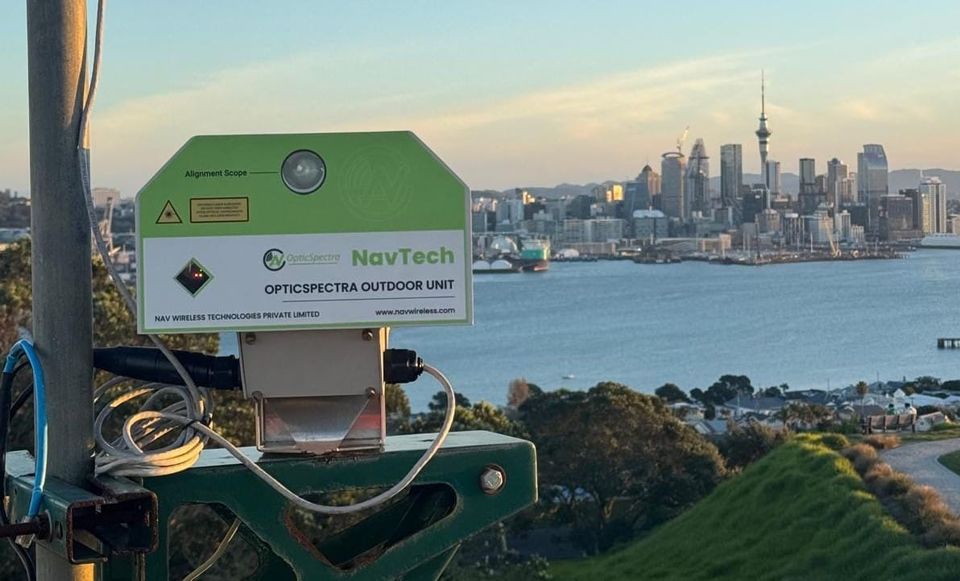
A laser link between the University of Auckland and Takarunga/Mount Victoria in Devonport shows how optical technology could provide a high-speed backup to fibre connections. It is also potentially useful for locations where laying cable is difficult.
Auckland company 9Rayz installed equipment developed by Indian technology company Nav Wireless Technologies to connect the two sites that are 4.5 km apart.
The Waitematā Harbour system operates at 1 Gbps using highly directional light rather than radio spectrum and can automatically adjust its aim to compensate for movement. Because the system uses light rather than radio frequencies, it does not require a radio spectrum licence.
9Rayz director Falgun Patel says the 1Gbps system can connect over 10 km while a 10Gbps system is suitable for shorter links.
Testing under conditions
During a demonstration the unit was connected using a 1 Gbps Ethernet interface. It was tested at close to full capacity transferring a 3 GB file
Patel says the link is robust and has remained connected during strong winds, although latency increases during the worst conditions. The system automatically realigns while the beam remains within its alignment range. The equipment monitors the connection and can generate alerts if performance deteriorates.
He sees potential for the technology as a backup to fibre, particularly in remote areas where cables cross bridges or other infrastructure vulnerable to flooding. One advantage is that setup only takes three or four hours.
In other news...
- Big tech threatens TVNZ and other local streamers — The Post
TVNZ chief executive calls for a level playing field. - British Telecom finds gold in the old copper network — Guardian
Recycled copper price rising on fear of a worldwide shortage. - Half of all Americans say they spend too much time on their phone — Pew Research
Few are successful at cutting back on their use.
Digital Island to offer RingCentral AI unified comms
Digital Island will offer RingCentral’s AI-powered unified communications, contact centre and customer engagement services to New Zealand businesses.
The locally owned cloud provider will design, implement and support the suite, which includes RingCentral’s agentic voice AI platform for autonomous workflow and call handling. Digital Island is trialling the service with early adopters ahead of a wider launch later this year.
This time last year the TCF report noted fibre’s success
The 2025 TCF annual report highlighted fibre’s success story and the value consumers get from telecommunications. The report said fibre accounted for 74 percent of all connections, a long way ahead of Australia on 40 percent and the OECD average of 36 percent.
Ten years ago Waikato Networks took control of Ultrafast Fibre
Waikato Networks paid $189 million to take control of Ultrafast Fibre which was jointly owned with Crown Fibre Holdings (CFH). The transaction took place three years ahead of schedule.
Ultrafast fibre was sold to First Sentier Investments, an Australian asset management company in September 2020. That business has since rebranded as Igneo, while Ultrafast Fibre changed its name to Tuatahi First Fibre in 2021.
Download Weekly is a New Zealand telecommunications industry newsletter written by Bill Bennett. You are welcome to pass it on to your friends and colleagues. While the newsletter is free, reader support helps enormously. A banner at the top of the page will take you to the support site.
Have your say. Sign up as a subscriber, it is free, to comment on any of the stories on this site. We don’t collect any personal data other than an email address.
Member discussion