
One NZ makes first 5G standalone call

Upgrade will add capacity and security
One NZ has completed its first 5G standalone test call, using a dedicated 5G core built with Ericsson. Chief technology officer Sharina Nisha and chief executive Nick Judd spoke on the link.
Seven years after commercial 5G first launched in New Zealand, local mobile networks have mostly run in non-standalone mode, relying on legacy 4G core infrastructure. Moving to a pure 5G core allows carriers to finally deliver on early industry promises of ultra-low latency, higher capacity and automated security.
Enterprise applications and network slicing
The upgrade enables network slicing, a technology already being deployed locally by Tū Ātea for Wellington's CentrePort, allowing One NZ to split its physical network into virtual channels tailored to specific enterprise applications such as automated manufacturing, logistics and precision agriculture.
Nisha says; “What's particularly exciting is that 5G standalone allows us to think beyond traditional mobile connectivity. We will be able to tailor network capabilities to what businesses and applications actually need."
One NZ trails rival Spark, which kicked off a $40 million to $60 million standalone upgrade with Ericsson and Red Hat in 2023 and already operates a commercial 5G standalone core powering its Spark 5G+ event service. Meanwhile, 2degrees selected Nokia for its 5G core in 2024 but has yet to announce a standalone launch.
Internationally, New Zealand lags early adopters such as China, where standalone networks have been standard for years, though fewer than 80 operators globally had launched commercial standalone services by late 2025. One NZ has not set a commercial launch date, saying it needs to complete further integration and testing.
ComCom proposes keeping fixed-line interconnection regulations
The Commerce Commission has recommended keeping fixed-line PSTN (public switched telephone network) interconnection regulated under Schedule 1 of the Telecommunications Act 2001.
While landline use continues to fall alongside rising mobile and internet-based calling, the regulator found that network operators still hold technical monopolies over completing calls to their customers. Maintaining regulation preserves a backstop for wholesale negotiations and protects businesses relying on 0800 and geographic numbers.
The Commission confirmed that its technology-neutral interpretation of PSTN interconnection includes fixed VoIP services.
Submissions on the draft report close on 17 December 2026, ahead of a final recommendation to the minister by 28 April 2027.
GTA 6 breaks Chorus peak traffic record
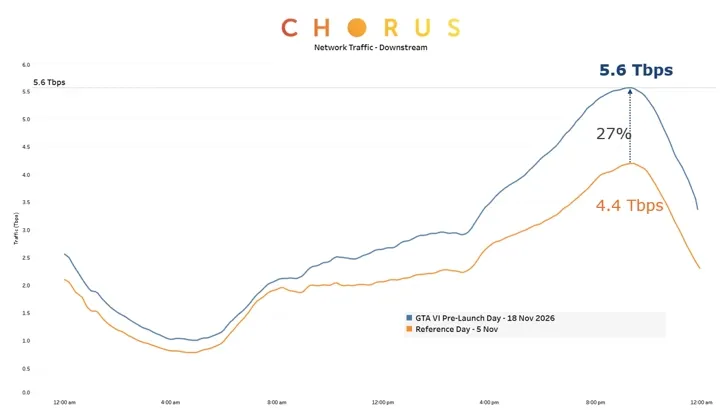
Chorus network strategy manager Kurt Rodgers reports the latest instalment of the Grand Theft Auto game has broken the peak traffic record on the fibre company’s network.
At 9:30pm on November 18, Chorus saw traffic hit 5.6 Tbps. This beats the previous 5.4 Tbps record from February 2025 when Fortnite Chapter 6 season two was released.
Spark: half NZ businesses are cyberattack victims
Almost half of New Zealand businesses have faced a cyber incident, yet more than half lack a resilience plan, according to a Spark survey of more than 400 business leaders. Only 44 percent have a plan, and just 16 percent regularly test it.
Despite 48 percent experiencing cyberattacks—the number rises to 58 percent among larger firms—businesses are under-prioritising critical tech investments. Fewer than a fifth plan to prioritise cybersecurity (19 percent) or network infrastructure (18 percent) over the next year. Meanwhile, basic protections like mobile security controls (30 percent) and AI policies (33 percent) remain scarce.
Spark General Manager Sam Thumath warns that low-impact attacks create false confidence, urging leaders to build strong data and connectivity foundations rather than treating resilience as a shelf document.
One NZ completes six-store retail rollout
One New Zealand has reopened its refreshed Botany Town Centre store in Auckland, concluding a 2026 physical retail expansion that added or upgraded six locations across Auckland, Christchurch, Tauranga and Palmerston North. Each opening included a whakatuwheratanga with local iwi.
Amazon Leo satellite setback
Amazon’s broadband constellation suffered a major setback when 40 satellites failed to make it into orbit. The failure was the first Amazon launch using a rocket specially designed for the company’s low Earth orbit satellites.
The mission was scheduled to be the first of 38 using the rocket. Amazon has not said if its plans are on hold after the rocket failed 10 minutes into the launch.
Amazon currently has more than 200 satellites in orbit and had previously said it would launch its satellite broadband service in 2026.
In other news
- One NZ plays important role in Infratil result — NZ Herald (paywall)
Operating earnings up 10 percent to $324.3 million. - Can we now have a rational debate on AI and data centres? — Listener
Peter Griffin argues a Democrat victory in the US mid-terms will shift the mood around AI and data centres. - Wellington Town Hall case study — Wombat.net
How a small service provider solved a coverage problem.
-Fax machines roar back into life — RNZ
Obsolete technology enjoys a day in that sun thanks to Microsoft outage. - Starlink is throttling Ukrainian satellite services — BBC
Slow data speeds mean disruption to the country’s defensive capabilities. - Why the satellite industry must think smarter — Satellite Today
Large Leo constellations are inherently inefficient, delivering low returns on capital. - Agritech addresses data compatibility — Farmers Weekly
Linking data from different apps and services was near impossible. - How telecoms upgrade work sparked US flight chaos — BBC
Move from copper to fibre behind the outage.
Russell takes chief commercial officer role at Connexa
Connexa has appointed John Russell as its new chief commercial officer. He officially joins the telecommunications infrastructure company in early February 2027.
Russell brings extensive trans-Tasman telecom and digital infrastructure experience, having previously held senior leadership, strategy and M&A roles at LVP, GigaComm, Indara (formerly Axicom) and Vocus Group.
This time last year: Tū Ātea builds CentrePort’s private 5G network
Tū Ātea used Māori‑owned spectrum to build New Zealand’s first private 5G network. The network at Wellington’s CentrePort provides site-wide connectivity for port infrastructure including the cranes, trucks and sensors that handle around 4 million tonnes of freight each year.
Five years ago Enable upgraded fibre speeds
The Christchurch-based fibre company upgraded customers on 100Mbps plans to a new base of 300Mbps. Enable followed a similar move by Chorus, which increased network speeds as a way of shoring up fibre broadband’s competitive position in the wake of competition from fixed wireless and satellite technologies.
Ten years ago we looked at the impact of fibre on market competition
The Download Weekly is a New Zealand telecommunications industry newsletter written by Bill Bennett. You are welcome to pass it on to your friends and colleagues. While the newsletter is free, reader support helps enormously. If you are reading this for work, donations are tax-free. A banner at the top of the page will take you to the support site.
Have your say. Sign up as a subscriber, it is free, to comment on any of the stories on this site. We don’t collect any personal data other than an email address.
Bill Bennett has covered New Zealand telecommunications for nearly 40 years and was named Tuanz Journalist of the Year 2025.
Member discussion